Saturday, February 07, 2009

Back to Work

After four and a half months off work—the longest non-working period in my adult life—I was afraid I had forgotten all the medicine I ever knew. Fortunately, such was not the case. I started working again in mid January, and everything has gone smoothly, with the help of several dedicated people in Bethel.

My entire job now consists of doing Radio Medical Traffic (RMT), which I described in detail in the early days of this blog; see this post and this post. The best part is that I am doing it from my home in Kenai. That is a luxury I have never had before, and I absolutely love it. The hospital sent me an industrial-strength printer/fax machine capable of cranking out hundreds of faxes per day without breaking a sweat. And the technology department is working to set up a laptop computer for me that will have the database for all 20,000 patients in our region on it.

This is not an EMR (electronic medical record). Individual patient visits are not electronically recorded into the database, which is known as RPMS, and I have no idea what the letters stand for, something about Patient Management. We are still handwriting patient visits! What RPMS provides is a health summary for each patient, with demographic information, chronic diagnoses, prescriptions filled, lab results for the past two years, radiology results for the past five years, surgical histories, and more. It is a thorough thumbnail of the patient; about the only thing it lacks are the details of any specific patient visit in the hospital. To get those, the hard copy of the chart must be ordered, which is something I can’t do from Kenai.

But if I really need those details, I can contact the medical staff’s administrative assistant and have her request the chart and fax me a copy of the relevant visit. So far, I have only needed her to do that once in the last three weeks. The process of doing RMT without access to RPMS feels somewhat like flying blind, as health aides often have questions about such things as availability of medication refills, or recent lab results. But the process has gone reasonably well even without access to the database since I started back. I am excited about getting a new laptop with RPMS on it, however.

And—what feels like icing on the cake—is that I will also have access to the telemedicine program on the laptop. Telemedicine has been in the village clinics for years, but most of the time was not utilized due to health aide resistance to learning the technology. That is becoming a thing of the past as younger people are entering health aide training who are more comfortable with computers.

The telemedicine carts in each village contain a computer tower/monitor/keyboard, a digital camera which can take still photos or short video clips, a camera mounted into an otoscope for taking pictures or videos of ear drums and other things located at the bottom of dark holes, an EKG machine, and all the software needed to transmit this info confidentially to Bethel or to Anchorage. It is an invaluable tool for doing distance triage on patients with things like rashes, where a picture is worth a thousand words, or patients whose complaint is simply “heart feels funny.”

The telemedicine carts in each village clinic have been replaced this past month with the absolutely latest and best that technology has to offer. And the health aide training program has made it a high priority to get all health aides trained up and comfortable in using that technology. It will help to make assessment of distant patients so much easier and more accurate.

Talking to health aides about their patients has always been enjoyable to me; I really like doing RMT. I have the greatest respect and admiration for health aides. They do a very tough job, and generally do it well.

All the 160+ health aides in our region are Alaska Natives, and most were born and raised in the village where they work. Given that most villages have less than 500 people in them, they are generally related (“somehow” as they say) to everybody who lives there. That makes it even tougher when the job requires attending to serious trauma or illness, and the patient is a loved one.

Health aides are trained to use language that is descriptive without being diagnostic. Lung sounds may be “snoring” or “scraping” or “popping.” Patients are “sick-weak-and-tired” or they aren’t. Really sick babies have “heavy eyes.” Translating these descriptions into accurate assessments can be challenging at times.

One of the more interesting comments I’ve received recently from a health aide was that a patient’s urine looked “thick.” I had to wonder what thick urine looks like. Honey? On questioning, the health aide said the urine wasn’t “junky” or cloudy, and dipstick test revealed a normal specific gravity (less than 1.020, therefore not concentrated, indicating no dehydration) and negative for nitrites or blood, indicating a low likelihood of bladder infection in a non-pregnant patient.

I asked the health aide to send a clean catch sample of the urine in to the lab in Bethel for culture and sensitivity, and a dirty catch sample for gonorrhea and chlamydia testing. The health aide and I agreed that the patient could be encouraged to increase fluid intake and be observed for new or increasing symptoms and rechecked in a few days—sooner if worse, as always.

Chief complaints for which patients seek care in the village clinics can also be puzzling. Last week, an otherwise healthy, twenty-something male came to the health aides for a complaint of “can’t burp.” He looked fine, had no complaint of abdominal discomfort or cardiac symptoms, and attributed his complaint to being “aired up.” In the Yupik concept of physiology, being “aired up” can explain anything from chest pressure to flank pain. It may mean nothing serious or it may mean time to medevac the patient in to the hospital.

In this patient’s case, a man who was young, looked fine, had no complaint of pain and had normal vital signs, I was not overly worried. I suggested to the health aide that he try drinking carbonated beverages for a day or so and recheck if he developed new or worsening symptoms. Our patients are generally very reliable for rechecking with the health aides when they perceive anything to be wrong; he has not returned to the village clinic in the subsequent few days, so presumably he is feeling better and burping away.

And then there was the best chief complaint maybe ever. “I want a pregnancy test.” The patient was a seventy-five year old woman. She was many years post-menopausal (or “menopaused” as the health aides say), but because she had all the reproductive parts, she was sure she could be. The health aide and I laughed about it as he explained that she is recently remarried and she and her new husband are “very active.” Good for them! The pregnancy test was negative.

Being back in contact with the health aides has been wonderful for me. It keeps me in touch with what is going on health-wise in the villages, and provides an opportunity to catch up on how the health aides I’ve known for years are doing. It has also made me aware of how much I miss doing hands-on patient care.

And for that, there is the best news possible: tomorrow I fly out to Bethel for a week of seeing patients at the outpatient clinics in the hospital. I hope to be able to make such trips about every other month. After four months away, it feels a bit like going home, and I’m really looking forward to it. Surely, a few blog posts will result.

Labels:

Monday, October 29, 2007

More Napaskiak Photos

Claire sent me a few photos from her camera--some of which I took--so I will add a short addendum to the previous post and share them with you.


The clinic staff, who took such good care of us while we were in Napaskiak, Katya, Harold, and Aggie. The lead health aide, Julia, was off the week we were there.


Village transportation. Four wheelers are the best way to get around in the village. There are no streets or roads in the village that a car or truck could drive on. A few people have them for driving up to Bethel in the winter on the ice road, but must leave them parked at the edge of the river. The only pathway through the village is the boardwalk, which is about eight feet wide and constructed of wood right on the ground. Whole families pile on these small ATVs; I have seen as many as ten people at once--without a trailer--riding on a four wheeler. Interestingly, unlike the village of Pilot Station on the Yukon River, people here do not refer to them as "Honda", though almost all of them are.


.
.
Our winged chariot. Note the visibility of the tree
line, which was not far away. The weather was going down, as we say around here. "Weather permitting" is a very real concept with direct application to our lives. Village travel in the winter often involves being on weather hold. Claire and I were both ready to get home, and really glad when the plane actually showed up
.
.
.
.

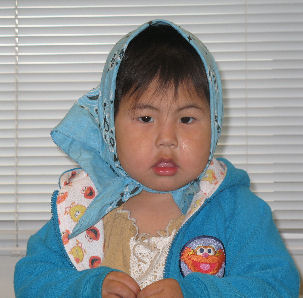
Claire and the crying baby who did not want to leave her grandma. Once she stopped crying, she never said a word. Wouldn't tell us her name or how old she was. She just sat on Claire's lap and stared silently out the window. Fortunately she was not fighting us, and did not seem mad any more. Probably just scared at being handed over to strangers. When we found her mother in Bethel, she said the baby's name is Michelle and she is 3 years old. By the time we left the waiting room with our luggage, she was running around with several other children, laughing and talking a mile a minute in both Yupik and English.

Photos with Claire by The Tundra PA; photos without Claire by Claire.

Labels:

Wednesday, October 24, 2007

Village Trip to Napaskiak

One of the more unique aspects of my job—and one of the most enjoyable—is traveling to a village and spending several days working with health aides and seeing patients in the small village clinic. Life has a different pace and a different focus in the villages, and it is refreshing to experience that.

Napaskiak is a Yupik Eskimo village of about 370 people located 14 miles downriver from Bethel. The people of this village have relatively easy access to Bethel for shopping and health care compared to people from the farther villages. Napaskiakers easily travel in by boat in the summer and by snowmachine in the winter. During the difficult transition periods around breakup and freezeup of the river, they come by small planes operated by the commercial charter services which offer scheduled service; a round trip ticket is about $120 for the seven-minute flight.

After three years as the assigned health care provider for this village, I finally had the opportunity to make an official hospital-sponsored village trip last week. It was the first time they had had a provider visit in four years.

Pulling off a village trip that runs smoothly requires some planning and preparation. The health aides are notified as far ahead as possible that the trip will happen and are encouraged to begin putting together a list of the patients they consider the most ill, the most fragile, the most home-bound in the village. They are also asked to start creating a list of equipment and supplies that they are short on. The Village Operations department of the hospital does a good job of supplying the village clinics, but many health aides tell me that at times they just can’t get certain things. The tiny blue ear scoops for removing ear wax is one example.

The hospital, of course, wants me to see as many patients as possible in the time I am there. And they want me to see all of the patients in certain categories: all the pregnant women, all the children under one year of age, all the people with diabetes, all the home-bound elders, and as many as possible of the patients who are on chronic medications. In addition to seeing patients, other activities are encouraged as well, such as going to the school and giving health talks to the students, or meeting with the village’s Tribal Council to discuss health issues of concern to them.

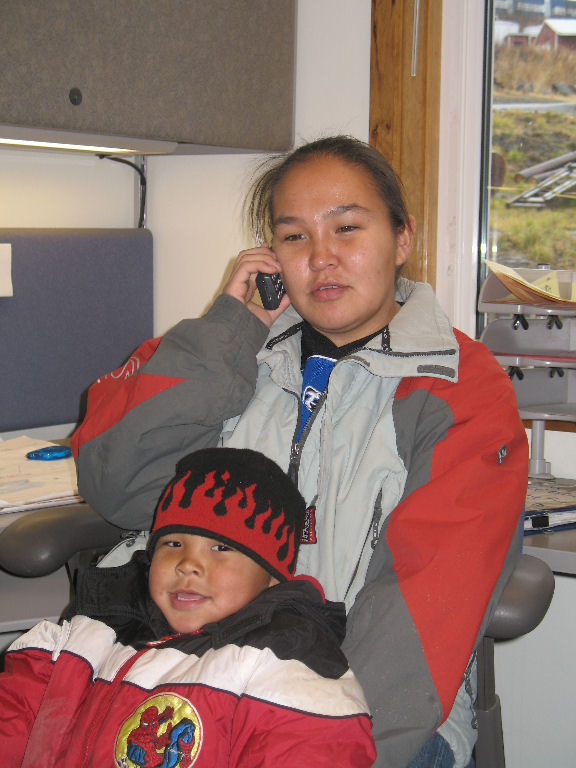
For this trip, I also had the pleasure of company. A newly-hired PA on our medical staff, Claire (NHRM), was assigned to go with me and learn how to do a village trip. Claire is a delightful and enthusiastic young woman who has been a PA for several years; she is excited about having moved to Bethel and taking up the work we do here with the Yupik people. She is a wonderful addition to the medical staff and I greatly enjoy working with her. This was her first village visit, and she was nearly vibrating in anticipation.

Our flight across the river left Bethel at 8:30 in the morning, just before sunrise. We were the only passengers in a small four-seater plane and the trip literally took about five minutes. We never flew above 300 feet. When we landed at the airstrip, the charter company’s agent was there to meet us on a four-wheeler pulling a small trailer. Our gear went into the trailer and Claire and I climbed on the four-wheeler behind the agent. He drove us over the boardwalk the half mile or so to the village clinic.

Napaskiak is laid out in one long line bordering a slough just at its entrance to the main Kuskokwim River. A well-maintained boardwalk extends from one end of the village to the other—perhaps a mile—with houses one or two deep on either side of the boardwalk. The houses are not numbered or named; everyone knows where everyone lives. The clinic, the school, and the store are located in the center of the village; the big Russian Orthodox church is at one end of the village and a small one is at the other. The post office is close to the small church.

Four-wheelers are the transportation of choice in Napaskiak. They go everywhere, and the boardwalk is wide enough for two vehicles to pass each other. Most people have a trailer to pull behind their vehicle; this is how they get their water. The village has a small water treatment plant with a large outdoor spigot labeled “Public Watering Point.” Homes have one or more 33-gallon plastic garbage cans designated as water containers; these are loaded on the four-wheeler’s trailer, filled at the Watering Point, and carried into the home to be dipped from as needed. Living with dipped water adds a whole other level of complexity to life; we easily take for granted the ease of turning a faucet in the kitchen or bathroom and having fresh, drinkable water flow out endlessly.

It was shortly after 9 am when we carried our gear into the clinic and greeted the two health aides, Harold and Aggie, and the clinic clerk, Katya. What we noticed right off was that they all had their coats, hats and gloves on. It was pretty chilly in the clinic.

“No heating oil,” said Harold. The clinic’s tank had run dry the evening before and the furnace had shut down. Normally the tank is refilled before it gets so low, but the entire village had been low on heating oil for several days. Fortunately, a fuel barge had stopped at the village the day before and filled the main storage tank, so the clinic’s maintenance man was able to go that morning and get fuel to restart the furnace. It would take several hours before the building was warm again.

Claire and I decided that the time could be best used by doing home visits on elders. Harold grabbed a couple of charts and the health aide home visit kit (BP cuff, oxygen saturation monitor, stethoscope, thermometer, first aide supplies) and the three of us climbed on the clinic’s four-wheeler.

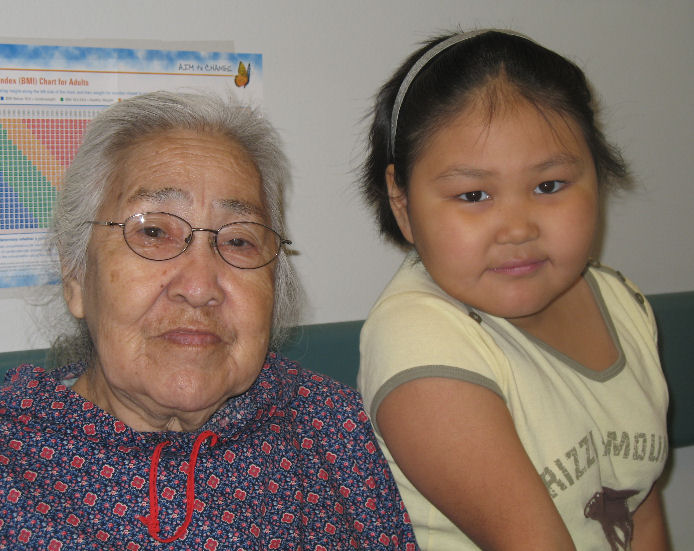
Our first stop was at the home of Lillian, the village’s oldest resident. Her age is listed in her hospital chart as 95 years, but her family says she is actually about six years older than that. Many elders in the Yukon-Kuskokwim Delta have uncertain birth dates; eighty years ago, such records were not kept. The local missionaries back then often assigned birth dates arbitrarily, and tended to use the date of first communion as the birthday.

Lillian welcomed us to her home, which was thankfully warm. She speaks no English at all, but Harold translated readily. She lives with her granddaughter, who takes care of her in the evening and does the cooking; but in the daytime she is home alone, as her granddaughter has a job. Lillian’s eyesight is failing but she gets around in the small house without bumping into things. She is at increased risk of falling, and we were there because she had fallen a few days earlier and the family was worried about her.

Claire and I checked her pretty thoroughly and she seemed well enough. Clearly there were no broken bones, and we only found one small bruise. Her upper and lower extremity strength were both quite good—likely the result of a lifetime of hard physical labor. A Yupik woman born in 1905 could expect nothing else. Her gait was slow and halting, but she picked her feet up well with each step. The family was hoping we could get her a wheeled walker to use in the house. I pulled out my clipboard and put that down as the first item on a list of things to be done on our return to Bethel.

The next stop was at the home of a man in his seventies who had had a moderately severe stroke some years earlier. His right arm and leg had marginal function. He sat in his wheelchair and could move around the house by pulling himself forward with his left leg. His wife wondered if we could get him a bedside commode, as she had trouble helping him get to the honey bucket in the middle of the night. Item two on the list.

Our third stop was to see a young mom who had called the clinic that morning because her two-week old baby was coughing. She has seven other children; the oldest three are in school, but the five-, three-, and two-year-old are home with her and the baby, and taking them all with her to the clinic for the baby to be checked was more than she could manage.

“Is it bronchiolitis?” she asked somewhat hopefully as soon as we were introduced. She knows about bronchiolitis. Most of her kids have had it and she is quite proficient with albuterol and a nebulizer. She is also experienced at “pounding”—percussion and postural drainage, or P&PD. If it were bronchiolitis she could keep the baby at home, give him albuterol nebs and P&PD every four to six hours and have daily rechecks at the clinic. Her fear was that this was pneumonia, which would mean a trip to Bethel and probable hospital admission for the baby. That would require a complicated arrangement between her sisters and aunties and her husband to take care of the other children while she was gone.

We unwrapped the baby near the living room window where the light was good and were reassured by his ease of breathing. No blue lips or nailbeds, no grunting, minimal retractions. His temp was 99.8 rectally, his heart rate was 158 and his respiratory rate was 62. The sat monitor read 94%. Yikes.

Mom knew he needed a neb treatment, but since it would be his first, she wanted him checked first. Oh, yes, I thought, let’s do that RIGHT NOW.

His breathing sounded junky, full of moist rhonchi that the health aides often describe as “snoring lungs,” but he was alert and looking around and moving all extremities. Mom quickly set up the nebulizer, poured an ampule of albuterol into the cup and had the baby breathing medicine in no time. After the treatment she turned him over in her lap and effectively patted his tiny back, helping him cough up the small mucous plugs that were interfering with his oxygen saturation. The monitor now read a reassuring 97% and his respiratory rate dropped to the low forties. Since he was afebrile and responded quickly to the albuterol, I was reasonably sure that this was bronchiolitis and not pneumonia. But lack of fever in a neonate does not necessarily mean lack of bacterial infection; the hospital has a standing order that all infants less than eight weeks of age come in for a septic work up, including lumbar puncture, for any fever greater than 100.3 degrees.

Harold, Claire and I agreed that the baby could be watched closely for the next 24 to 48 hours, with nebs every four hours and daily rechecks at the clinic. If he seemed worse at any time to Mom, or if his temp went above 100.3, he would go to Bethel. By Medevac if necessary.

We returned to a warm clinic just before noon. The staff went home for lunch and Claire and I unpacked our gear in the itinerant sleeping room, which has two bunk beds, a microwave and sink. No refrigerator. With daytime temps in the thirties and nighttime temps in the twenties, I figured I could keep the half-and-half for my coffee from either freezing or spoiling by putting it outside in the daytime and inside next to the back door at night. Worked perfectly. The frozen dinners we brought simply stayed outside all the time. Thank goodness for a microwave.

The next few days went by in a flash. Claire and I both saw a steady stream of patients, but the pace seemed much more relaxed than at the hospital. There were no emergencies to wake us up in the middle of the night, which can easily happen in the villages, and for which I was grateful. Our evenings were quiet; fortunately both Claire and I are avid readers and were happy to have time for it. There is a television in the clinic, but it only picks up two channels and both of them are quite fuzzy. I had hoped we would be able to take a steambath with some of the village women, but that did not happen.

Our last morning there, two young children were brought to the clinic who were both fairly sick. One was a two-year-old who had been taking albuterol nebs for a week or so, now weaned down to once or twice a day, but she had suddenly developed a fever of 101.8 and now had “heavy eyes,” a common health aide descriptor for lethargy. We gave her back-to-back nebs times three with P&PD after each neb, but she did not perk up much. Her temp came down to 100.2 with a dose of ibuprofen. I put a call in to the pediatrician on call in Bethel and we discussed the case. She needed to come in on the next commercial flight that afternoon; in the meantime we would do hourly nebs and watch her. Dad stayed at the clinic with her while Mom went home to pack.

The second young child was a one-year-old named Max with one of the worst cases of impetigo I have ever seen. He had been on topical mupiracin ointment and oral cephelexin for a week, and the infection was spreading and getting much worse. Blood cultures drawn at his visit in Bethel five days earlier were positive for Staph. Though his temp was 101 and his rash looked horrendous, he was a smiling, happy, drooling baby.

This time I grabbed the digital camera from the telemedicine cart and took photos of Max. Then I logged on to the telemedicine program and created a case presentation for him: his demographic info, a brief history of this episode of illness, and the photographs. I sent it to the pediatrician in Bethel and then called her and told her it was coming. She pulled up the case, reviewed it with me, and we decided that Max also needed to come to Bethel on the afternoon commercial flight.

Claire and I finished up with patients about 3 pm and got paperwork and supplies packed that we needed to take back with us to Bethel. The agent for the charter company called at 3:30 and said that our two sick children and their mothers would be taking our seats on the flight. We were bumped. They would try to get another plane out in about two hours to get us, but weather was closing in and they might not make it. I looked out the window to see snow falling rapidly and visibility about half what it had been an hour earlier. “Welcome to the bush; it is all part of the experience,” I told Claire.

We had planned our food well, and neither of us had any left. I laughingly told Harold that he would have to cook dinner for us if we did not make it out that night. “You’ll make it,” he said seriously.

At 5:15 it was still snowing fairly heavily when the agent called again and said a plane would be coming for us in about thirty minutes. We piled our gear in the trailer and hopped on the four-wheeler behind Harold. Snow was stinging my eyes and my hands were freezing with fleece gloves on as we roared up the boardwalk to the airstrip. Harold was barehanded and did not seem to mind. “It’s not winter yet!” was all he said when I mentioned it.

No plane was in sight when we got to the airstrip, but another four-wheeler was waiting. On it was a young girl of 14 or so, an older woman and a screaming toddler. The girl and the woman patiently watched the sky. The child just screamed. Thank goodness this is a short flight! I thought to myself.

Soon we heard the buzz of the plane’s engine and in no time it was pulling up in front of us. The people on the other four-wheeler had no luggage and just watched as Claire and I handed ours to the pilot who stowed it. We climbed into the six-seater and buckled ourselves in. Then the older woman came forward with the toddler and tried to put her into the plane. The child screamed even more, she fought, she tried to hold on to the woman.

“Would you hold her?” the woman said to Claire.

“Oh, well, sure,” Claire responded, thinking the woman wanted to get herself strapped in without fighting the child to do it.

“Thanks,” she said. “Here’s her bag. Her mother will be waiting in Bethel.” And with that she handed over a tiny purse-like bag and backed away from the plane! Claire and I looked at each other in disbelief.

The child was no longer fighting, but she was still screaming. Claire, mother of a toddler herself, put her arms around the little girl and began singing a lullabye. The child became quiet almost immediately. Crocodile tears shined in her eyes, but she did not make another sound.

“What do we do if her mother is not there?” Claire asked me.

“Let’s just hope she is,” I said.

We walked into the small waiting room in Bethel, which was full of people, carrying the silent child. “Is this child’s mother here?” yelled Claire over the din of many conversations. We looked around. No one came forward. After we toured the room repeating the question, a very thin young woman said “My baby!” At the sound of her voice, the child started crying. Mom comforted her and by the time we had collected our luggage she was smiling and laughing.

Claire and I looked at each other and laughed as we walked out the door. “Welcome to the bush!” we said in unison. It wouldn’t happen anywhere else.


Photos by The Tundra PA. Stories and image of Max and Lillian used with their family's permimssion.

Labels:

Monday, September 03, 2007

A PSA Story, Part 2

This post is a follow-up to a previous post about Evan, my patient with a very high PSA. I should have mentioned that it was with his permission that I wrote about him, and that (of course) Evan is Not His Real Name.

It has been a month since I saw him in the clinic. He started taking Septra (trimethoprim-sulfamethoxazole) the next day and had no side effects from it. Several days later I received the results of the urine culture and sensitivity. The bacteria causing his infection were Kluyvera ascorbata, sensitive to ciprofloxacin.

I had never heard of this bacteria, and it seemed odd to me that it would be sensitive to ciprofloxacin but resistant to a six-week course of levofloxacin. I called my urology consultant. He had also never heard of the bacteria and was equally puzzled by the sensitivity report.

“Talk to an infectious disease person,” he said. “But go ahead and switch him to ciprofloxacin.”

Infectious disease (ID) is one of the few specialties that we do not have a consultant for at the Alaska Native Medical Center in Anchorage. To get an ID consult, I have to call the University of Washington in Seattle. They maintain a 24-hour phone consultation service—for every known specialty—known as Medcon.

I was quickly connected to an ID fellow and presented Evan’s case to him. He said that Kluyvera is a recently-delineated subgroup of Escherichia, the common gut bacteria that cause most urinary tract infections (the “E.” of E. coli). He was as puzzled as the urologist and I had been that it was sensitive to ciprofloxacin but apparently highly resistant to levofloxacin.

“Ciprofloxacin does have more specificity for the prostate and concentrates in the tissue better than levofloxacin does,” he said. “Definitely put the patient on six weeks of it, and then do follow up cultures.” He also agreed that with such a large post-void residual (300 mL), the patient needed to be self-cathing to help resolve the infection.

I sent an order to the pharmacy to send out ciprofloxacin to Evan’s village and notified the health aides that it would be coming and that Evan needed to start taking it right away. He could stop the Septra, as the bacteria were resistant to it.

The issue of teaching Evan to self-cath was somewhat trickier. I knew it was unlikely he would be able to fly in to Bethel just for this. If he were from one of the nearby villages on the Kuskokwim River, I would jump in my boat and go visit him at the village clinic to teach him how to do it. But his village is not on the Kuskokwim. I considered flying to his village on my day off, but did not really want to bear the expense of that myself (several hundred dollars). Then I remembered another resource: the public health nurses.

PHNs are employees of the State of Alaska. There is a long tradition here of village visits by PHNs and a more clinical focus to their work than in other places. The earliest access that Alaska Natives had to western medicine was provided by public health nurses who traveled by ship to the coastal and riverside communities. When I first came to Alaska, the PHNs made regular trips to all the villages in the Delta, providing well-child care, immunizations, Pap smears, and exams for sexually transmitted infections. Recent budget cutbacks have curtailed much of their travel, but PHNs still make some village visits.

I called their office and learned that Evan’s village had visit coming up. I spoke with Pam, the PHN who was going out and told her about Evan’s case. She said she would be glad to check up on him and teach him to self-cath, but she did not do prostate exams.

The day after her visit she called me to report that Evan was taking the ciprofloxacin without any problems, and that he was feeling much better. He could now urinate without any discomfort; but he still had the pressure sensation in his pelvis, which he continued to describe as “poking” pain. It was somewhat improved, though.

When I first saw him, he had reported a sense of incomplete emptying after urination; that, too, was now gone. Pam taught him to self-cath, which he was able to do without difficulty, though he really didn’t want to. And he had NO post-void residual. She marked the catheter for depth of insertion and measured it at over twice the length of his flaccid penis. I was delighted with this news; I immediately called him and said that he only needed to self-cath if the sense of incomplete emptying returned. He was quite happy about that.

In a few days it will be four weeks since Evan started taking the ciprofloxacin. I will call the health aides in his village and ask them to draw blood for a PSA level and get urine for urinalysis and culture. I am deeply hopeful that he has cleared the Kluyvera and that his PSA is back down to something less than 10. There is still the issue of whether I really felt a nodule; that follow up will require at least a trip to Bethel, and at least two digital rectal exams—mine and Dr. H’s. I want confirmation from a more experienced prostate examiner that a nodule either is, or is not, present. With these added data points I’ll consult the urologist again and we will arrange whatever next step Evan needs.


Labels:

Saturday, August 04, 2007

A PSA Story

He was the last patient of the morning, and as usual, I was running about an hour behind by the time I got to him. He had a twenty minute appointment for abdominal pain. He was the third abdominal pain patient that morning; the first two had been women of reproductive age who also had twenty minute appointments.

The first thing he told me when I walked into the room was that he had to make his 3:00 check in to catch the last plane home. He had borrowed the $200 plane fare from his village council to come in for the appointment, and he couldn’t afford to stay over. He barely had money for lunch.

A bandy little man in his mid-forties, Evan (e-VAN) might weigh 135 pounds with all his clothes on and his pockets full of pennies. His round face and full cheeks proclaimed his Yupik Eskimo heritage. His English was good, so we didn’t need an interpreter.

I reviewed his chart before going into the exam room. I know several of his family members, but had never seen Evan before. He has had complaints of lower abdominal pain and dysuria (painful urination) for several months. He came to the hospital about two months earlier and was seen by one of the physicians in my clinic. Her work-up included a clean-catch urinalysis (CCUA), which showed more than five but less than ten white cells, and a few red cells; a complete blood count (CBC) with slightly high white cell count at 15,000; and a prostate specific antigen (PSA)--drawn before the prostate exam--of 11.6.

What? 11.6?? Holy cow. The top end of normal is 4, and the highest PSA I’d ever seen (not doing a lot of men’s health) was just over 7. But 11.6? Wow. She documented a normal and unremarkable prostate exam and diagnosed prostatitis. He was given a six-week course of levofloxacin and told to follow up in two months. Unfortunately, no urine culture was done.

The day before I saw him, he had gone to the village clinic and reported that he still had the abdominal pain, it still hurt to pee, and he was tired of how long this was taking to get better. He took all those pills the hospital sent out, so why wasn’t he any better? The health aide reported him to me during radio medical traffic; I did not have his chart in front of me, but said what I always say in such cases: any time the patient does not get better, he or she needs to come back to Bethel for a re-check. Especially for a complex complaint such as abdominal pain.

“The problem,” the health aide told me, “is money. He has no income, he lives by subsistence. He is uninsured.” Meaning no Medicaid to pay for his travel. As an Alaska Native, his health care and all his medications are free to him; but the transportation to get to that care is up to him. I asked her to see if his family or the village council could loan him the money to fly in, but did not know the outcome until the next morning when I saw his name on my patient schedule. I was relieved to know that he had made it.

Before I went in to see him, I had my nurse draw his blood for a PSA, ask him to void spontaneously for a CCUA, and then straight-cath him to get a post-void residual. She did; he had 300 milliliters of retained urine, which is high for a relatively young man.

He looked quite well. He had normal vital signs and was sitting comfortably in the chair. I had watched him walk in from the waiting area, and he moved easily. His manner was shy and soft-spoken; he answered questions clearly and was an excellent historian. He confirmed that he had taken every single one of those big antibiotic pills for a full six weeks.

“Even I took them,” he said, “I never got better. It stings when I pee, and it is poking pain down here.” He gestured to the supra-pubic area.

His abdominal exam was benign, no mass, no tenderness. His genital exam was normal. His rectal exam revealed a normal rectal sphincter and vault, with no evidence of an abscess. His prostate, however, was huge.

Now, the caveat here is that I have not done all that many prostate exams. I know boggy from firm, and normal from enlarged, and I have felt an asymmetric prostate. But I have never felt a prostate nodule, and I could not begin to estimate gram-weight based on my digital rectal exam.

Evan’s prostate was the biggest I had ever felt. With him bending over the exam table, my finger went straight in and then straight up. The consistency was firm and the shape seemed symmetric. He had the usual discomfort with the exam that most men do, but no remarkable level of pain. But then, on the left lower side, I noted a difference in texture. More hardness. Was it a nodule? I wasn’t sure. It caused him no additional discomfort when I pressed it.

With the exam over, Evan went to have lunch while we waited for the lab to report the CCUA and the PSA. Once I had those results, I would call the urologist in Anchorage for a consult.

The CCUA came back quickly, and showed thirty to fifty white cells, ten to twenty red cells, and positive nitrites. He definitely had a urinary tract infection. Since he reported no improvement with six weeks of levofloxacin, it was probably the same infection, resistant to that antibiotic, and now worse. Since a culture was not done, we can’t know for sure.

I waited all afternoon for the PSA result. My nurse called the lab several times and was told it wasn’t ready yet. While I waited, I talked to my favorite consulting physician, Dr. H. He is a family practitioner (FP), and one of the smartest docs I have ever worked with. I also just like him a lot, and enjoy learning from him.

When I told him about the physical exam and my concern that I had felt a nodule in Evan’s prostate, he held out his arm with the wrist extended. Pressing the bony prominence just distal to the radial pulse, he said “prostate nodule.” Pressing the large muscle at the base of the thumb, he said “normal prostate.” Pressing the space on the back of his hand between thumb and forefinger, he said “boggy prostate.” Okay, that was definitely a nodule that I felt.

Three o’clock came and went and Evan left to fly home to his village. Finally, about 4:30 I called the lab to find out what the delay was on the PSA. The lab tech apologized for the delay and said that he had never had so much trouble running this test before. He had to do multiple dilutions in order to get the machine to give a result. He had just finished the final run, and was reporting Evan’s PSA at 38.9. My heart sank.

I dialed the Alaska Native Medical Center in Anchorage and asked for the urologist on call, glad once again for the excellent specialty consultation and referral service we have available around the clock. He was on the phone with me in less than two minutes. I presented Evan’s case to him, and after hearing all the details, he gave me reassurance.

“A PSA that goes that high, that quickly, is highly unlikely to be cancer. If it is, then it is exceedingly aggressive, and the patient has an extremely poor prognosis. Much more likely is that this is prostatitis caused by a bacteria resistant to levofloxacin. Too bad a culture wasn’t done last time.”

He wanted more definitive imaging before speaking to the question of the nodule I felt. He asked if our ultrasonographer could image the prostate trans-abdominally; he knew we do not have a trans-rectal probe. I checked, the answer was no. He wondered if Evan might have a prostate abscess; he has seen very few of those in Alaska, but it is a possibility. He also wondered how well Evan would do with self-catheterization four times a day. “As much as patients don’t like it, it is the best thing for them when there is that much residual. It will allow his bladder to cycle, and keep him from re-infecting.”

“Start him on Septra, and then adjust according to sensitivity when the culture result comes back. Call me in a few days when you have that information,” he said.

Though it was after closing time for the village clinic, I called and was happy to find one of the health aides still there. I told her to call Evan and ask him to come by first thing in the morning to pick up the medication. I trust that he will, and that he will take every last pill we give him.

What I keep thinking about is that through this entire two months, Evan's complaint has always been that he has pain, never that he feels sick. He has never had fever, been nauseated, had a change in appetite or change in stool. His prostate is certainly large enough--swollen?--to cause the "poking" pain he describes.

But despite the reassurance, I am still worried about him. I know I felt a nodule. Regardless of infectious issues, he needs to go to Anchorage for definitive imaging of his prostate, and appropriate follow up with the urologist. When I spoke to him about possibly going in, he said that he could not go alone. “I’m not a city boy,” he said. “I’ll get lost.” The look in his eyes spoke volumes. He doesn’t have $500 for his own plane ticket, much less $1,000 to bring along an escort.

Somehow we will see to it that he gets there, and gets the care he needs. Stay tuned for the rest of the story…

Labels:

Monday, April 23, 2007

When the Provider Becomes the Patient--Part 2


The orthopedist called my family practice doc, Dr. H, this afternoon. He said that the MRI revealed a labral tear of my left hip. It is analygous to torn cartilege in the knee. Apparently these are fairly common, and sometimes they are not at all painful (I wish!). Treatment for them is symptom driven. The next step, if it doesn't get better spontaneously with rest and pain control, is an x-ray or ultrasound guided steroid injection into the hip. If that fails, then arthroscopy of the hip to remove torn labrum. Both of these would mean travel to Anchorage.


But first, rest and healing. If it is not better in two weeks, then I will consider the next step. Dr. H and I discussed a treatment plan, which will include regular visits from my wonderful body worker Anna, who is a physical therapist as well as a myofascial release worker and masseuse. I'll do everything I can to help this injury heal as quickly as possible.
Photo of Bethel sunset, 9:04 pm mid-April, by The Tundra PA.

Labels:

Sunday, April 22, 2007

When the Provider Becomes the Patient


It has been quiet on the blog for the last week because I have been in too much pain to work, to play, or to write. It finally reached the point where the provider had to become the patient, negotiating the health care system as it exists in western Alaska.

It all started a few weeks ago, when I had a bizarre mushing accident on my last dog run with Henry. It was on my birthday, actually. (Yes, that makes me an Aries, and a pretty typical one, from what I know about it.)

At the very end of our good snow, Henry and I went out with seven dogs on what we figured would be the last good run of the season. The weather was fairly warm, about 20 above, and we’d had a good six inch snowfall a few days earlier, probably the last we would get.

We were having a great run. The young dogs were performing well and all were lively and energetic. I was riding in the sled and we came around a sharp bend in the trail. A large birch tree with perhaps a three inch diameter trunk was leaning across the trail, right in our path. The dogs went under it easily, but it clearly was going to hit the sled, and maybe bust the driving bow—and possibly Henry’s hand.

I stuck my right foot up to deflect it as we went by, as most of our birch trees are pretty flexible. This one was not. It was solid as a rock, and like hitting a wall, it stopped us hard. The tree rammed my foot back so that I was hyperflexed at the knee and hip, and wedged firmly between the tree and the sled. I couldn’t move, and my knee was next to my ear (a place it hasn’t been in years, I can assure you). When we hit, I screamed. Then I yelled “Back up! Back up!”

Henry was able to yank the sled back a few inches, and I got my leg down. I waited for pain to appear, but there was none. I had felt nothing snap or pop. Gingerly, I stood up and walked around a little, and there was still no pain. Henry was nearly freaked. He thought I must have dislocated my right hip. Apparently not. We made it back to the dog yard without any further problem. I told him that I thought we had dodged a bullet that time.

About three days later, my left hip began to hurt. It bothered me off and on for about two weeks, and then suddenly began to get really painful. After about five days of escalating pain, it became excruciating. I had x-rays done; no fracture.

I was off work and on hydrocodone four times a day for pain control. As soon as it wore off, the pain was right there. I was limping heavily on a cane and not sleeping well at all. Pain was exacerbated by hip extension and medial rotation, and relieved somewhat by partial hip flexion.

My FP, Dr. H, looked at the films and discussed them with the radiologist. They both felt that I should have an MRI of my hip to look for soft tissue damage, and see an orthopedist for further evaluation. That meant flying to Anchorage, as we have no MRI or CT available in Bethel.

On Friday, Dutch and I flew over. I saw Dr. L, the orthopedist, in the afternoon, and focused plain films again showed no fracture, though he felt that the physical exam was consistent with one. The MRI was scheduled for Saturday morning, after which we could return to Bethel. He will see the films and discuss them with the radiologist on Monday, and call Dr. H with the results.

The MRI was the most painful experience I can remember. The test itself is painless. It was the position I had to maintain for about twenty minutes that was the problem: fully supine, legs straight with toes taped together and heels about a foot apart. I could not achieve the position without pain, and within moments I was in agony. By the end of the test I was sobbing and begging the technician to turn the equipment off and let me flex my hip and knee. The pain was so intense that I was hyperventilating, and a mild tetney response set in. Breathing shallow and fast blows off too much carbon dioxide, leading to hypocapnia which causes muscle contractions of the face, drawing the mouth into an “o” and which can cause temporary flexion contractures of the wrists and hands. The lips and fingertips tingle, and getting one’s breathing under control (deep and slow, deep and slow) can be difficult.

I was wheeled back out to the waiting room looking quite the mess—red, swollen eyes and pale, sweaty complexion. Dutch said I probably scared the other people waiting there.

After a bit of rest I felt much better, and Dutch and I went to our favorite coffee shop for a light lunch. We even managed to do a little shopping in the afternoon before catching the evening flight back to Bethel. We both arrived home exhausted.

So I am still limping, not sleeping well, and taking opioid medication for pain control. And I still don’t know what’s causing the pain. I hope the MRI revealed some indication for it. At least then I’ll know how long this may last.

Labels:

Sunday, January 07, 2007

Yupik Eskimo Diet and Obesity


Obesity and diabetes used to be virtually unknown among the Yupik Eskimos of southwest Alaska. Their traditional diet reflects their hunter-gatherer lifestyle: it consists mostly of meat, fish, berries, and a limited selection of greens and vegetables that grow wild on the tundra. Some Yupiks still eat a predominantly traditional diet, and have little trouble with obesity.

The infiltration of Western culture into this region has brought many changes, most of them good. Medical care is far more accessible; infant mortality rate and death from infectious disease are greatly reduced. Transportation and communication are much faster and easier. Availability of goods and services from outside the region is greatly improved. The arrival of the Western diet, however, has had deleterious effects on the health status of the Yupiks.

Western culture got its first modern-day toehold in this region about 150 years ago, with the arrival of the Moravian missionaries in the 1860s. For the first hundred years or so, the number of Caucasians was small enough to have little effect on the Yupik culture outside of the religious arena. Fifty years ago, the only noticeable effect of Western presence on diet was the addition of flour, sugar, and margarine, available from the white traders. Bread, either fried or baked, thickly spread with margarine and topped with sugar became the usual breakfast of many Yupiks.

In the 1950s, Bethel had a population of about 800 people, of which less than 20% were non-Native. Today Bethel’s population approaches 6,000, and half are non-Native. This influx represents a huge injection of Western culture in the region. From a dietary perspective, this means soda pop and candy in the grocery stores, and hamburgers and pizza in the restaurants.

The effects are felt in the villages as well as in Bethel. Almost every village has a store or trading post which sells canned and packaged foods which are ordered from the stores in Bethel or Anchorage. By far, the most-shipped item by weight is soda pop. Tons of it are shipped to the villages every year. It is not uncommon to find children who drink six or eight cans daily. Combined with candy and irregular tooth-brushing behaviors, the effect on their teeth is predictable. Many children here have full-mouth silver capping of their deciduous teeth, done in the OR under general anesthesia.

The other effect of so much sugar in the diet is obesity. It has practically exploded as an epidemic in the Yupik population in the last twenty years. Of course, sugar is not the only culprit. Pasta, rice and Crisco have also become staples of the Yupik diet.

Activity levels in daily life have also changed with the advance of Western culture. Snowmachines and four-wheelers have decreased the amount of walking that most people do, and there are far fewer dog teams to care for because of them. There is less need for chopping wood and hauling water with the advent of oil-burning stoves and indoor plumbing. Children’s entertainment more often involves television and video games than active physical activity.

The Yupik people as a whole tend to put on excess weight as truncal obesity—the classic “apple” shape. They refer to themselves as “top-heavy” when they are obese. A three hundred pound woman may be huge from shoulders to hips, but have relatively skinny arms and legs and practically no butt. When she sits, her pannus may come nearly to her knees. Overall, the Yupik are also fairly short people; average height for women is 60-62 inches, for men 64-66 inches.

One of the strategies for making inroads into the obesity epidemic among the Yupik is to encourage a return to traditional culture. “Stop eating Western junk food, you weren’t made for it; eat your traditional diet,” is what we advise. There is a strong resurgence of pride in their culture going on, and many younger people want to focus on this. The difficulty is that their traditional diet is a lot more work to acquire. The grocery stores don’t sell moose, beaver, swan or salmonberries. Dried pasta, on the other hand, is cheap, light to pack and has a shelf-life of years.

The diabetes education team is working hard to bring home the message about the connection between obesity and diabetes. The team includes a registered dietician who helps people adapt ADA (American Diabetic Association) recommendations to the Native lifestyle. They have folks wearing pedometers and striving for “thirty actives minutes per day”. Bethel residents are encouraged to join Weight Watchers and to participate in the hospital’s Biggest Loser program.

In short, the obesity epidemic which is overtaking Americans is not limited to the lower 48 or to the non-Native populations. An endless supply of cheap food which is always available, combined with decreased activity levels overall, has gradually fattened us as a nation. A tendency to turn to food for comfort in times of stress, isolation or despondency contributes to the fattening in the high-stress times we live in. The bottom line is as simple as it is difficult. Eat less. Exercise more. And curse your genes if you come from a long line of fat people.

Labels:

Sunday, December 17, 2006

Practicing Bush Medicine


Southwest Alaska is a huge geographic area within which to provide medical care. It the size of the state of Oregon, and contains one single small hospital. The health aides in each village are the starting point of a system of care which works well most of the time. Health aides consult daily with their village’s assigned provider (physician, physician assistant, or nurse practitioner) regarding the patients they see in their small remote clinics; these consults are collectively called Radio Medical Traffic (RMT), which I have described previously. The primary question to be addressed for each patient through RMT is whether that patient needs to come to the hospital in Bethel or can be observed and treated in the village. Many times that question is not easy to answer.

The first consideration is always: how sick is the patient? Any person in any village who is seriously, emergently ill will be medevac’d (weather permitting, of course, and sometimes it doesn’t). Health aides are very astute at differentiating the patients needing medevac from those who don’t. They stabilize the patient to the best of their ability, maintain frequent phone contact with the ER physician in Bethel, and pray for clear weather while waiting for a plane to come and get the patient. That wait may last an hour, or a day. If the patient is a pregnant woman in pre-term labor, they may deliver a baby before the plane arrives. The health aides in one of the Yukon River villages successfully delivered a 36-week double footling breech infant during a bad snowstorm when the plane could not land.

For patients who are less acutely ill or injured, the decision to come to Bethel for evaluation has other considerations, primarily financial. It often comes down to who has Medicaid or private insurance, and who doesn’t, especially for the residents of the more distant villages. Doing a quick mental tally, I believe there are nine (out of 58) villages that are within a thirty mile radius of Bethel, and so reasonable to travel in by boat or snowmachine for non-emergent health needs. The rest must come by small plane.

Any patient in our region can make an appointment in the Family Medicine Clinics for any reason at any time, if they choose. By treaty agreement with the federal government, Alaska Natives receive 100% free health care, including all prescriptions and over-the-counter medications, any needed supplies for things such as wound care, and any necessary medical equipment such as home hospital beds, nebulizers, wheelchairs, home oxygen concentrators and bedside commodes. Transportation to receive the care is the weak point in the system. If the appointment is not considered necessary by the provider in Bethel doing RMT, then the patient will have to buy the plane ticket—generally one to three hundred dollars round trip, depending on distance. Neither Medicaid nor private insurance will pay for transportation beyond the closest point of contact where service is available. They will not pay for a trip to Anchorage if the needed service is available in Bethel, or a trip to Bethel if the service is available at a sub-regional clinic closer to the patient’s village. If the patient simply wants to go to the higher level of care, they may do so at their own expense.

For the provider doing RMT on non-urgent patients, there are several agendas going on which must be kept in mind. From the hospital’s perspective, the RMT providers are the floodgate-control operators. They can direct the health aides to send in every patient with puzzling or slightly concerning symptoms for further evaluation. When one is new to RMT, the temptation is very strong to do just that; the questions of “what if the patient gets worse quickly?” or “what if the weather goes down?” are always present in the back of one’s mind. The problem is the overwhelming volume that would create. Two to three hundred patients per day are triaged through RMT. The hospital’s outpatient clinics and ER are already operating at or near capacity most of the time, with a medical staff that is undersized for the job we face, and overworked.

From the health aide’s perspective, a moderately ill patient in the village who is being watched and rechecked daily increases the likelihood of pulling an all-nighter at the patient’s bedside and then having to work the next day. When any patient is challenging the limits of their ability to give care, the health aides (understandably) do not want that patient in the village. The difficulty for the RMT provider is in assessing just where that line lies. Some health aides, whether by the nature of their personality or by the amount of experience they have, are less comfortable with even mildly ill patients being treated with watchful waiting, with or without oral antibiotics. Health aides sometimes lobby hard for their patients to be “trafficked” in to Bethel, even though the physical exam may not support the need for it.

From the patient’s perspective, traveling in may be highly desirable or absolutely despised. If the patient doesn’t really feel terribly ill, and could use a shopping trip to town, he or she may be pressing the health aide to request further evaluation in Bethel. If the patient does feel somewhat ill (or “sick-weak-and-tired” in the language of the Community Health Aide Manual), getting on a small plane in often marginal weather to be bounced around for an hour or so and then waiting an hour or more in the always-crowded hospital lobby with other sick and coughing people is not a welcome suggestion. Some patients would rather stay home until they get sick enough to need medevac.

A single RMT provider may triage as many as a hundred patients in an afternoon. When the traffic is heavy and the faxes are coming in from the health aides by the handfuls, it is important to move quickly, scanning the Patient Encounter Form for serious concerns or exam findings, and establishing a plan of care and follow-up. With such heavy volume, it could be easy to miss crucial details; fortunately that doesn’t often happen because health aides don’t miss much and are strong advocates for their patients.

Doing high-volume telephone triage with health aides through Radio Medical Traffic requires a bit of juggling to balance the actual needs of the individual patient, the collective needs of 160 health aides in 58 villages, and the capacity of a small hospital to provide top-notch medical care in a severe and remote location. There is not a lot of fat in the system; we operate most days with very tiny margins. To the credit of the entire team, we usually make it work.


Photos by The Tundra PA

Labels:

Sunday, November 26, 2006

Steambath Boil


Author's note: the accompanying photo is not the patient described in this story. The story is fiction.

Enakenty is 81 years old. He lives in a downriver village just far enough away from Bethel to make it difficult to come in to the hospital, except by plane which he generally can not afford. He receives a small pension from his years as a riverboat pilot, so does not qualify for Medicaid, which pays for travel. As an Alaska Native, his health care is 100% free to him, once he is in Bethel or Anchorage; but getting there to receive it is up to him. He speaks only Yupik, his eyesight is failing, and he seems occasionally forgetful to his family, so he is not safe to travel alone. The escort’s ticket to Bethel is an extra $150; to Anchorage is an extra $500. If he really has to come in, he prefers one of his sons to bring him; but sometimes he just refuses to come. “It’s my life!” he says.

Enakenty has three sons and two daughters, all that are left of the ten children he and his beloved Gertrude gave birth to during their forty years of marriage. Together they buried five small children, victims of disease and drowning. Twelve years ago he had stood silently watching as his sons dug their mother’s grave among those small headstones. Even now it is sometimes hard to believe that his Gertie is gone. Cancer of the pancreas. So fast, barely six months from the time she got sick until she was buried.

Now Enakenty lives with his youngest son’s family. Carl and his wife Unda only have three children; his other two sons and both daughters have five to seven kids each, and they really don’t have room for him. As the youngest child, Carl’s siblings fully believe it is his responsibility to care for their dad far more than it is theirs; that is the job of all youngest children, what they were born for. When the youngest child is a girl, she may not be allowed to marry prior to her parents’ deaths, as that would allow her husband to take priority over her parents.

Fortunately, Carl is very fond of his dad, and is usually the one who brings him in to the hospital for clinic visits. Unda is fond of the old man too, and truly does not mind his living with them. He is a wonderful storyteller, and can keep her three children mesmerized with a story in the evening. And he is a very good ivory carver. Her ten-year-old son, Nicodemas, frequently badgers his grandfather to teach him to carve. Unda hopes the boy has his grandfather’s skill for the craft; a good ivory carver can make a significant income by selling his work. The pain in Enakenty’s arthritic hands keeps him from producing more than one or two nice pieces per year, but the money from them is always welcome.

The old man loves to take steambath. He and his sons usually steam together three or four times a week, most often in the bathhouse built by his oldest son, which is right between their two side-by-side houses.

About five years ago, Enakenty accepted an invitation to steam at a bath across the village. It was not very clean, and Enakenty had not brought a piece of cardboard to sit on inside the bath. He considered declining but did not want to appear rude, so went into the bath and sat on the dirty floor in his bare skin. Soon after that bath, he developed a boil on the back of his right thigh.

For a week he tried to care for the boil at home. He started doing frequent warm packs. He tied a red string around his leg above the boil to prevent the infection from going up higher. He chewed large wads of tobacco until they were juicy with saliva and then taped them over the growing boil. By the fifth day the pain in his leg was intense, and he couldn’t walk without limping. He could barely sit down. On the sixth day there was a four inch red streak ascending toward his hip; the boil was a golf ball of hardness surrounded by fourteen centimeters of hot redness. He felt hot all over and a little bit sick.

The health aide simply raised her eyebrows when she saw the huge abscess and said “Why’d you wait so long to come in?”

He shrugged. “Thought it’d get better.”

Christine was a Session III (of five) health aide who had just taken “Boils 101”, the new inservice for health aides on incision and drainage of abscesses, and she knew this needed draining badly. “Gotta get the pus out,” she muttered to herself as she pressed gently around the boil, trying to find the spot where the boil was making its own pathway of relief. No natural opening was yet apparent. She hated causing the grunt of pain that Enakenty could not hold back every time she pressed.

“Enakenty, this boil is big, and it’s really deep. It has to be cut or it won’t get good. It’s making you sick,” she said, noting his temp of 100.6 degrees. “You need to go up, and let ‘em take care of it up at Bethel.”

“Can’t,” he responded. “No money to go. You can do it, I trust you. Just poke me hard with that knife and let’s get it over with. I’ll take the pills.”

She put a page in to her village doc at the hospital, who called back shortly. He agreed that Enakenty needed I & D right away. He went over the procedure with her and assured her that she could do this, despite the fact that it was her first one since the inservice.

“Give him 800 mg. of ibuprofen with a little food about 30 minutes before you do it,” the doc said. “Be sure to culture the pus, and start him on Septra twice a day for ten days. Call me back if you have any problems, OK? And do daily packing changes for a week or so.”

The I & D went smoothly, and Christine removed about a half cup of pus from the abscess. Enakenty asked for a bite stick to clamp between his teeth, to help him take the pain. Afterward she packed a foot of sterile gauze ribbon into the wound. She sent him home with antibiotics, more ibuprofen, and instructions to continue frequent warm packs and return the next day for repacking. She also told him he had to stay off the leg and elevate it. “No walking around, OK? You have to rest!” His only response was a noncommittal grunt that could have meant anything.

When he returned from the clinic, Unda was waiting for him. She settled him on the sofa where he could reach his crutches and piled up some pillows to elevate his leg. A homemade cloth bag filled with dried beans went into the microwave; when it was very warm she tied it to the back of Enakenty’s leg with a wide strip of cloth.

With Unda watching closely and reheating the bag of beans frequently, the old man spent the next five days on the sofa with his leg elevated. The Septra caused no side effects, and his fever and the pain improved rapidly with ibuprofen. He saw one of the health aides daily for packing changes, which were the most painful part of the whole ordeal.

Just pulling the long, pus-soaked ribbon out of the wound was painful. It burned deep, and he squeezed his eyes shut against it. But worse than pulling was replacing. By the fourth day, the wound still held nearly a foot of ¼” wide gauze packing without being tight. Every time the tweezers stuffed a bit of gauze into the wound, he flinched. If the tweezers touched the sides, it hurt even more. By the third repacking, he would not let anyone but Christine do it. She never let the tweezers touch the sides.

It took a full week of repacking, but the abscess finally healed. The red streak disappeared by the third day of antibiotics; cultures indicated that, like most boils in the villages of southwest Alaska, this one was MRSA, and sensitive to Septra. Enakenty was glad he wasn’t allergic to it, like one of his daughters. By the fifth day he no longer needed the crutches, but still spent hours on the sofa with his leg elevated, entertaining his four-month-old granddaughter.

After the boil healed, a small scar remained. It was Enakenty’s reminder always to take boil precautions in the steambath; he never again forgot to bring his own piece of clean cardboard to sit on in the bath, and he kept a spray bottle of bleach solution to clean the floor with after steaming in the bath he shared with his son. In the years since, Enakenty was proud that no one had come away from his family’s steambath with a boil.

.

Labels: